
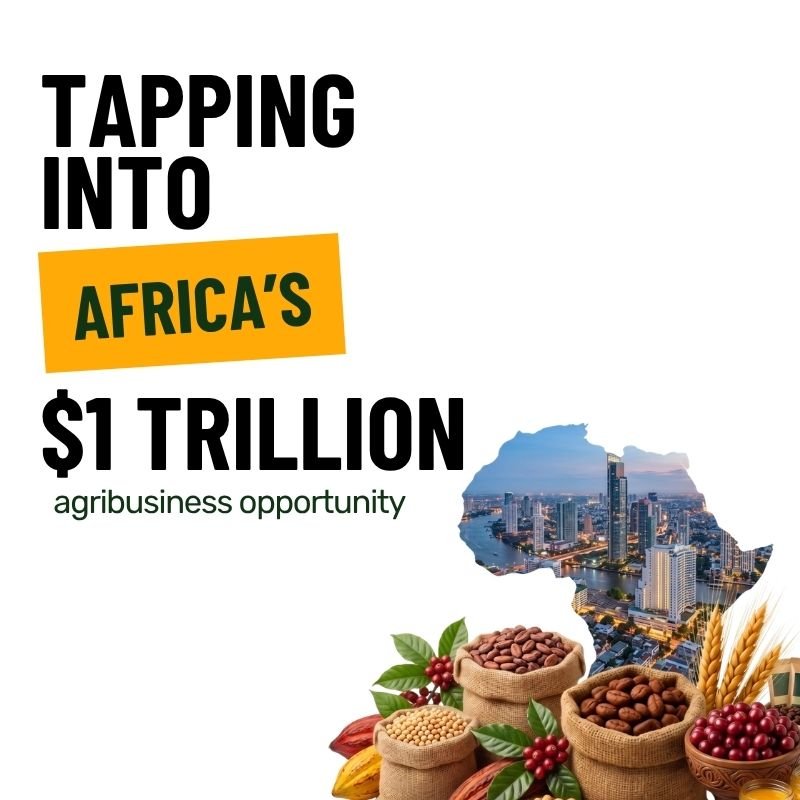
Big numbers lose their weight when they get quoted enough times. A trillion dollars is one of them. That is the projected value of Africa’s food and agribusiness sector by 2030, and it turns up in work from the African Development Bank, the World Bank and the Brookings Institution. It is not wishful thinking either. The figure rests on measurable trends: a growing population, rapid urbanisation, and a food economy already estimated at around 280 billion dollars and expanding.
So the useful question is not whether the opportunity exists. It is who ends up holding it, and what they had to build to get there.
Consider what feeds the projection in the first place. The continent’s population should cross 1.7 billion before 2030 and move towards 2.5 billion by 2050, and all of those people eat every day. Rising incomes change the shape of that demand as well as its size. Households move away from plain staples and start buying dairy, poultry, fish, fresh produce and processed foods. That is where margins live. For most of its modern history, African agriculture has been organised around growing raw commodities and exporting them almost untouched.
The commercial opening today is in everything that happens once the crop leaves the field. Processing, packaging, cold storage, haulage and distribution are the activities the trillion-dollar forecast is really measuring.
For a single business, that distinction changes the whole strategy. Producing a good crop has rarely been the difficulty for African farmers and processors. The difficulty is holding on to the value afterwards. Converting a raw commodity into something packaged, processed and branded that a buyer will pay more for is the step that someone further along the chain has usually taken, and frequently someone based off the continent entirely.
Getting into this market therefore means choosing one position in the chain and becoming genuinely capable there, instead of attempting the whole chain at once. For one business that might mean buying modest processing equipment so cassava leaves the premises as garri rather than as cassava. For another it might mean securing the cold storage arrangement that keeps perishable goods intact until they reach a regional buyer, rather than watching them spoil in transit. For a third it might be the packaging and paperwork that lifts a product from informal local sales into something a registered distributor will stock.
None of this depends on waiting for national infrastructure to catch up first, real as those gaps are. What it does demand is an honest look at where the business currently sits along the chain, and a clear plan for climbing one rung higher. When this market finally reaches its projected size, the firms still trading will be the ones that started that climb early, while position was still cheap to take.
#SellerAfrica #ShopAfrican
#AfroCaribbeanMarketplace